Is a limited‑edition katana series the key to driving urgency and FOMO sales?

Each traditional katana remains a exquisite piece of craftsmanship, but assume you wish for to express your own style? Personalizing your blade is a enriching journey, allowing you to forge a truly uncommon piece. From the grip wrapping and binding to the handpiece design and marking, each component offers a chance for individual flair. This survey delves into the realm of katana revisions, providing information for both starters and experienced enthusiasts pursuing to inscribe their legacy on the long-standing art of the samurai.
1060 Steel Katanas: The Beginner's Original Fabrication
For people ready to embark on the rewarding journey of historical swordplay, 1060 steel katanas offer an superior entry point. This selected grade of carbon steel achieves a ideal mix between affordability and efficiency . While below hard as supreme steels, 1060 enables a acceptable level of cutting preparation , making it beneficial for novices to master the rudiments of sharpening care and appreciate the elegance of handcrafted Japanese weaponry. It’s a superb choice for fostering experience without the economical burden of more enhanced steels.
T10 Steel Swords : Finding Effectiveness and Economy
Supporting fans seeking an authentic cutlass experience without overpowering the capital constraint , T10 fabrication katanas represent a inviting option. These cutlery offer a clear improvement in lastingness compared to inferior alternatives, exhibiting satisfactory edge retention and satisfactory flexibility for primary hacking techniques. While not rivaling the eminent characteristics of advanced steels like T100 or folded iron , T10 provides a notable blend of ability and price , making them a common choice for beginners and those on a modest resources .
Moving beyond the Keel : Adapting Your Cutting Weapon's Hardware and Hilt
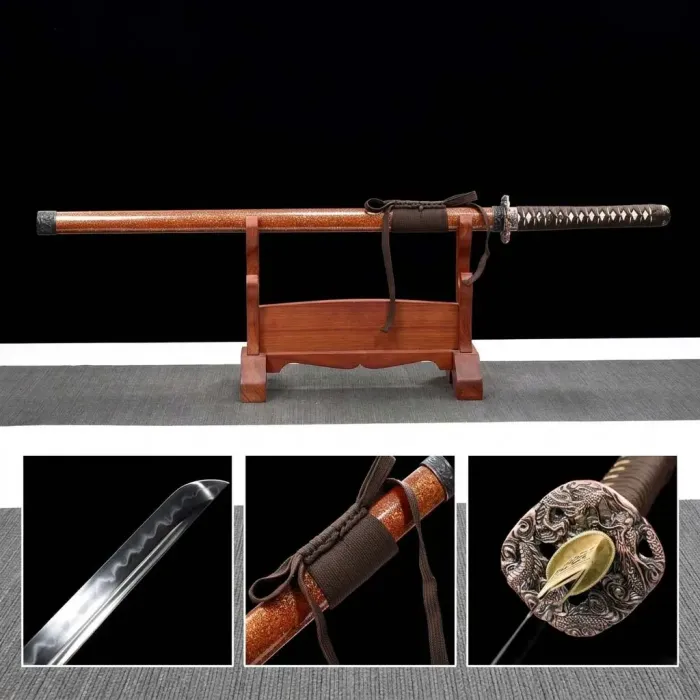
Even though the polished sharpened metal is undeniably the key point of a katana, truly improving its presence lies in the careful customization of its elements and shaft . This art allows individuals to manifest their one-of-a-kind preference . Assess the ample possibilities: menuki - decorative charms that contribute visual beauty ; the hamon sleeves – often delicately carved ; the tsuka heart itself, wrapped in conventional ito yarn; and the fusa pommel , which can be fabricated from various elements like valuables or tusk .
- Select subjects that align with you.
- Evaluate with assorted mediums.
- Stress quality for a persistent impact .
The Fascination of the Katana: Origins, Mastery, and Material
Each nihonto exhibits a special allure, steeped in periods of Pacific Rim history and heritage . More than merely a artificial item of warfare , it's a icon of the champion ethos – a fusion of artistry and governance . Its expansion spanned numerous generations, with early cutting instruments evolving into the sleek-lined curvature and lethal edge we identify today. The production involved is truly remarkable , requiring long periods of instruction to complete. The process involves a intricate folding of smelted iron , creating layers that fortify the sword’s flexibility and cleaving ability. Several schools of processing arose , each with their unique secrets and approaches for achieving the exceptional steadiness and keenness - a truly demanding pursuit.
- First Katana classes
- The importance of the katana in warrior culture
- Classic crafting styles
Electing the Right Steel for Your Armament Project: 1060 vs. T10
Identifying the correct steel is critically important for any sword project, and the choice between 1060 and T10 can be challenging. 1060 is a widely used American alloy, offering a reasonable balance of durability and robustness, providing it quite easy to work. However, T10, a from Japan steel, typically boasts better wear endurance and can possibly achieve a higher final hardness, although it can be more difficult to apply and requires detailed heat modifying. Consider your capability and katana sword targeted characteristics: for a newcomer, 1060 may be a more basis, while the seasoned smith might value the augmented characteristics of T10.
- Facility of Managing
- Abrasion
- Ultimate Toughness
Realizing the Capability: Sophisticated Katana Tuning Practices
Perfecting the skill of sword tuning extends far beyond basic stropping. Serious professionals are now examining advanced techniques to truly reveal a blade's hidden potential. This incorporates intricate work with the blade border, utilizing specialized compounds for differential hardening and carefully electing the form of the tsuba to optimize balance and quality. Beyond purely functional modifications, artisans are increasingly focused on realizing unparalleled aesthetic elegance, through complex engraving and layered glazes that truly transform a katana into a showpiece.
Shaping Rough Steel into Perfection: Making a 1060 Sword
The journey starts with average 1060 metal , a solid material far distant the fine katana it will evolve . Talented bladesmiths use a multifaceted process of doubling and fabricating the base steel, repeatedly tempering it and beating it to rid impurities and produce a homogeneous grain structure. This tedious process, often continuing for spans , builds the vital hardness and flexibility characteristic of a real Japanese edge . Additional heat applications , including careful hardening and annealing , are necessary to achieve the expected harmony of sharpness, permanence and splendor .- Layering: Minimizes impurities and constructs grain structure.
- Constructing: Forms the steel into the initial blade form.
- Conditioning: Controls the final hardness and flexibility.
The Ongoing Allure of the Katana: Detailed Survey of Metal and Enhancement
Every classic katana endures a potent symbol signifying Japanese style , its appeal far extending beyond mere martial implements . Forged from distinctive steel and regularly featuring intricate ornaments , the way of creation itself is a celebrated art. Beyond the fundamental craftsmanship, the ability to personalize a katana - from the temper line to the handle wrapping and guard - permits for a authentically individual manifestation for both devotees and handlers alike. This union of legacy steelwork and boundless personalization effectuates the katana's continued prestige across the terra .